

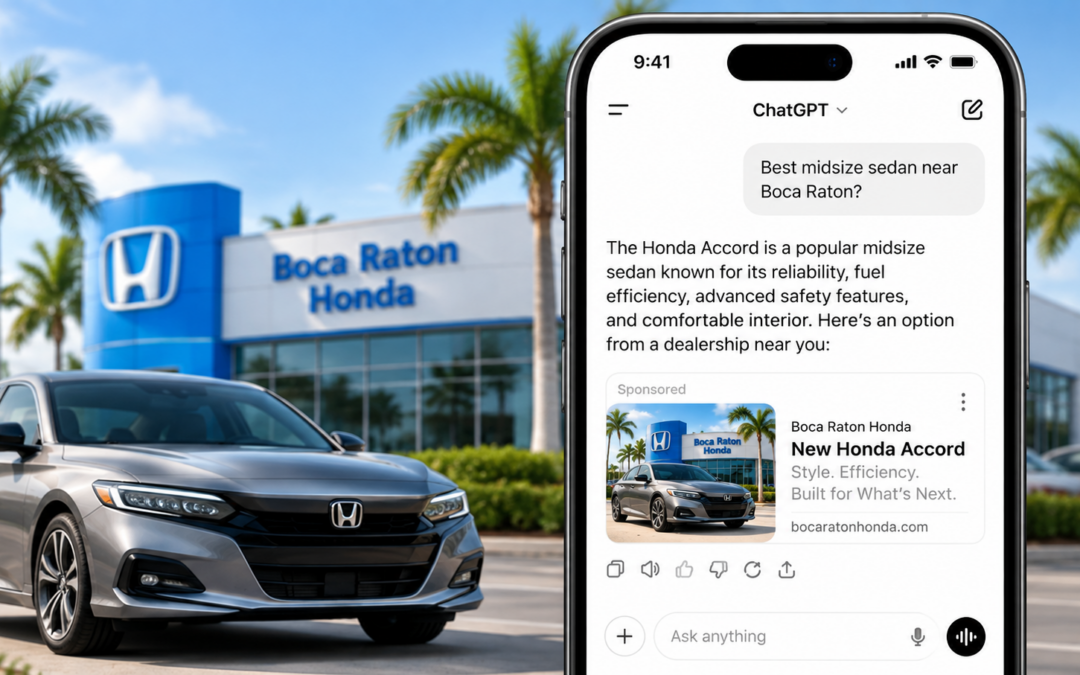
ChatGPT Ads for car dealerships are creating a new opportunity for dealers to reach shoppers while they research vehicles, compare models, evaluate features, understand payments, and decide where to shop.
As more consumers use conversational AI during the automotive buying journey, dealerships have another touchpoint where purchase decisions can be influenced.
For dealers, ChatGPT Ads shouldn’t be viewed as a replacement for Google Search, social media, or other proven channels.
It’s a new touchpoint in the automotive shopping journey — and one worth understanding.
What Are ChatGPT Ads?
ChatGPT Ads are sponsored placements that can appear below ChatGPT’s responses. Advertising remains clearly separated from the organic answer ChatGPT provides.
What makes the opportunity different is how relevance can be determined.
Traditional paid search generally begins with a keyword. ChatGPT can consider the context and intent of a conversation, along with the advertiser’s landing page, messaging, creative, and advertiser-provided context hints.
Those context hints help describe the types of conversations where an advertiser may be useful.
- Comparing two SUVs
- Looking for a vehicle with AWD
- Finding a truck with specific towing capabilities
- Researching hybrid vehicles
- Comparing trim levels
- Shopping within a specific budget
- Looking for local vehicle availability
Context hints aren’t exact-match keywords. They help the platform understand the broader needs and situations where an advertiser may be relevant.
Why ChatGPT Ads Matter for Car Dealers
Paid search is extremely effective when consumers already know what they want.
A shopper searching Google for “Ford F-150 lease deals near me” is demonstrating clear purchase intent.
But automotive shopping often starts much earlier.
“What’s the best three-row SUV under $50,000 with AWD and good cargo space?”
At that point, the consumer may still be deciding between several manufacturers and models.
That’s the opportunity.
ChatGPT advertising can potentially put dealerships and their inventory in front of consumers while the consideration set is still being formed — not just after the shopper has decided which vehicle to search for.
From Conversation to Inventory
For dealerships, the ad itself is only part of the equation.
The destination matters just as much.
If someone is researching a particular model, trim, vehicle category, or offer, sending that shopper to a generic dealership homepage creates unnecessary friction.
The better experience is to continue the conversation.
- A relevant SRP
- A specific VDP
- Model-specific inventory
- New vehicle specials
- Lease or finance offers
- Used or certified inventory
- Trade-in tools
The tighter that connection becomes, the better the opportunity to turn AI-assisted research into actual inventory engagement.
ChatGPT Advertising Requires a Different Creative Strategy
Automotive advertising has no shortage of generic messages: Huge Savings. Shop Now. Don’t Miss Out.
Those messages may still have a place, but conversational environments create an opportunity to be much more specific.
Instead of simply promoting the dealership, the creative should answer the shopper’s need.
Explore available models with AWD, advanced safety features, and flexible financing options.
See current hybrid inventory, features, and available offers from your local dealership.
That approach fits automotive particularly well because dealerships can develop messaging around different models, vehicle categories, offers, inventory priorities, and shopper needs.
How Dealers Should Measure ChatGPT Ads
Platform metrics such as impressions, clicks, click-through rate, spend, CPC, CPM, and conversions are useful starting points.
For dealerships, though, the bigger question should be:
- SRP engagement
- VDP views
- Lead submissions
- Phone calls
- Trade-in activity
- Appointment requests
- CRM attribution
- Vehicle sales
- Cost per acquisition
- Advertising cost per vehicle retailed
Like every automotive media channel, the closer dealers can connect advertising activity to their CRM, DMS, and actual vehicle sales, the more useful the performance evaluation becomes.
Should Dealers Be Testing ChatGPT Ads?
Potentially — but not simply because the platform is new.
The best approach is a controlled test built around a clear dealership priority.
- A high-priority model
- Excess inventory
- A conquest opportunity
- A new product launch
- A strong lease or finance offer
- A growing vehicle segment
Build the campaign around a defined consumer need, connect the messaging to relevant inventory, track what shoppers do next, and evaluate the results.
Then scale what works.
The automotive shopping journey is expanding. Dealers don’t need to abandon the channels already producing results, but they do need to understand where customers are researching and making decisions.
ChatGPT is increasingly becoming one of those places.
Frequently Asked Questions About ChatGPT Ads for Car Dealerships
ChatGPT Ads are sponsored placements that can appear below ChatGPT responses when an advertiser may be relevant to what the user is discussing or researching. Advertising remains clearly separated from ChatGPT’s organic response.
Yes. Automotive advertisers can use ChatGPT Ads to reach consumers during research, comparison, and consideration. Platform availability and advertising capabilities continue to evolve as OpenAI expands its advertising products.
No. ChatGPT Ads should be viewed as another part of the automotive media mix. Google Search remains extremely valuable for capturing shoppers demonstrating direct search intent, while ChatGPT can create additional opportunities during broader research and consideration.
ChatGPT advertising can use context hints that help describe conversations, needs, and situations where an advertiser may be relevant. Unlike traditional search keywords, context hints are not exact-match targeting rules.
The landing experience should match the shopper’s intent whenever possible. Depending on the campaign, that could be a VDP, SRP, model inventory page, vehicle special, finance offer, trade-in experience, or another relevant dealership landing page.
Dealers should evaluate platform metrics such as impressions, clicks, CTR, CPC, and conversions, but they should also connect performance to dealership outcomes including leads, calls, CRM activity, appointments, sales, CPA, and advertising cost per vehicle retailed.
Not necessarily. Dealers should approach emerging channels with a defined testing strategy. Start with a specific inventory priority, model, offer, conquest opportunity, or business objective, establish measurement, and increase investment if the results support it.
Preparing Your Dealership for the Next Search Journey
Automotive shoppers aren’t abandoning search — they’re expanding how they search.
As AI becomes another part of vehicle research and decision-making, dealerships need strategies that connect those conversations to relevant inventory, compelling creative, and measurable business outcomes.
Omni Advertising helps automotive dealers build integrated media strategies designed to reach the right shopper, with the right message, at the right moment — and connect those investments back to dealership performance.